

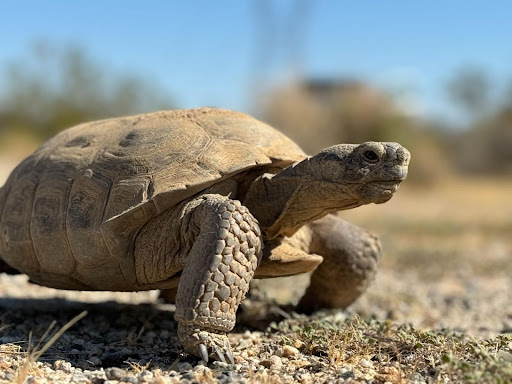
Photo credit: Kayla Thompson, Mojave Desert Land Trust
We’re pleased to announce a forthcoming paper featuring our work on survival estimation of the federally-threatened Mojave desert tortoise (Gopherus agassizii). Estimating survival can be difficult for at-risk species, which often persist at low densities, can be difficult to detect, and difficult to monitor across their ranges, yet these estimates are key to informing recovery actions. To overcome this challenge, CSP staff led a coordinated effort with partners from federal and state agencies to synthesize the largest demographic dataset for the tortoise to date, spanning nearly a half century (1977-2022) of data from multiple independent studies and long-term research plots across the range of the species.
We developed a novel modeling framework that allowed us to integrate two types of data and produce robust survival estimates. In radio telemetry studies, tortoises are fitted with tracking devices (radio transmitters) to monitor their movements and status, including pinpointing any mortality events. In capture-mark-recapture studies, tortoises are assigned unique numbers and markings to monitor populations in a specific area, although it can be tricky to distinguish between a mortality event and a tortoise moving to a new home outside of the research plot (i.e., emigration). In our model, we share information across data types to produce robust estimates of true survival that account for both emigration and mortality, revealing important effects of climate on tortoise populations that we could not detect in analyses with either dataset alone.
Our model revealed positive, lagged effects of precipitation and higher survival of adult males relative to subadult, juvenile, and female tortoises. Importantly, our results suggest that previous survival estimates for this species were negatively biased, painting a bleaker picture of tortoise survival and indicating a greater risk of extinction than we observed. Although we focused on the effects of climate in this analysis, our model can be applied to other stressors on tortoise populations and may be extended to provide updated survival estimates for other imperiled species. Indeed, we are applying the approach to efforts funded by multiple federal agencies, hoping to increase our understanding of tortoise demography, while increasing the pace of conservation efforts.