

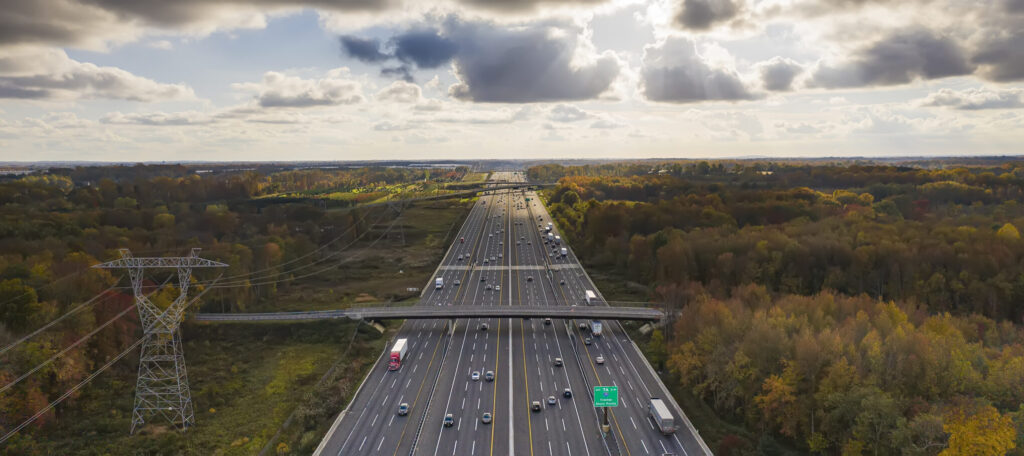
Photo credit: James Loesch, CC BY 2.0
A major new report from the Center for American Progress (CAP) and Justice Outside, The Nature Gap: Communities of Color and Those With Low Incomes Are Bearing the Brunt of America’s Nature Loss, draws on a comprehensive analysis developed by CSP to document persistent and deeply inequitable patterns in how Americans experience nature loss. The findings are stark: communities of color are three times more likely than white communities to live in nature-deprived areas, and three-quarters of residents of nature-deprived places have low household incomes. Who you are and where you live determines your access to nature, and the well being consequences that come with it.
More specifically, communities of color make up 74% of those living in nature-deprived places nationwide, with Black and Latino communities among the most affected — 55% of Black communities and 54% of Latino communities live in nature-deprived areas. The economic dimensions of these discrepancies are striking, too: nearly 74% of nature-deprived communities have low household incomes, and 70% are composed of severely cost-burdened households – i.e., those spending more than half their income on housing. The burdens compound further at the intersection of nature loss and climate risk, where 72% of communities of color live in areas experiencing both nature deprivation and the greatest exposure to extreme heat, compared to only 28% of white communities.
The analysis is grounded in a new metric developed by CSP — the Anthropogenic Impact Metric, or AIM — that goes beyond simply mapping where development and nature loss exist. Rather than treating human land use as a binary presence or absence, AIM combines a detailed land-use footprint with a continuous intensity layer that captures not only where humans are affecting the environment, but how severely. Overlaid with 57 indicators of social vulnerability — spanning climate risk, pollution exposure, and infrastructure access — as well as demographic data from the U.S. Census, AIM enables a granular, state-by-state accounting of who bears the greatest burdens of nature loss and environmental inequity across the United States.
This work is laying the foundation for an even more powerful analytical capability. CSP is currently developing a deep learning approach to detect and map human land use from satellite imagery across multiple points in time. The goal is to generate a time-enabled AIM that will allow CSP and its partners to track how anthropogenic impacts are changing on the landscape and to understand, with increasing precision, how different communities are bearing the brunt of nature loss as conditions evolve.
Read More:
A Fact Sheet can be found [here].
Conservation Science Partners (CSP). 2025. Revisiting the Nature Gap: Quantifying the discrepancies in access to natural lands among diverse communities, in light of conservation momentum – and potential backsliding. Preliminary Technical Report. Truckee, California, USA.
Zeno, S., Rashid, M., Rowland-Shea, J., Bailey, K., Payan, R., et al. (2026). The Nature Gap: Communities of Color and Those With Low Incomes Are Bearing the Brunt of America’s Nature Loss. Center for American Progress.