


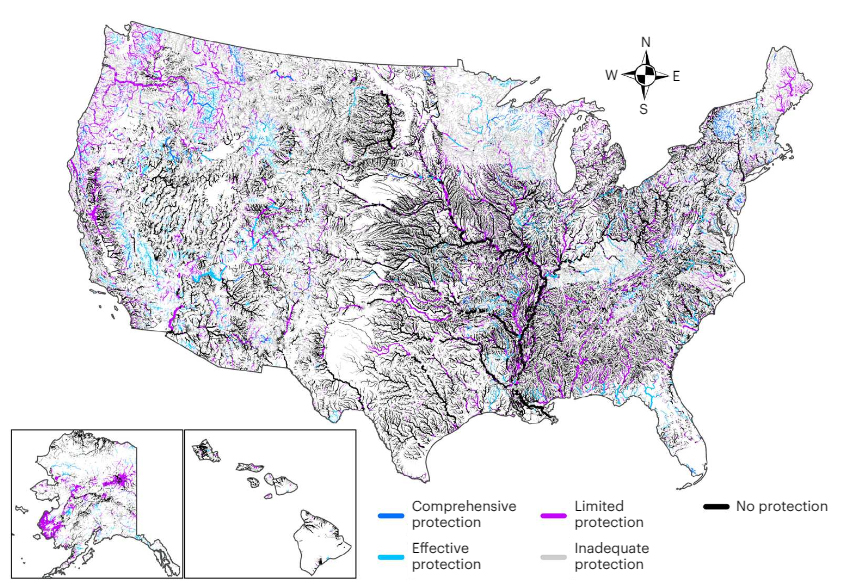
A groundbreaking assessment from Conservation Science Partners and American Rivers – the National Protected Rivers Assessment of the United States – reveals that just over one-tenth (11.7%) of river length in the contiguous United States and less than one-fifth (19.3%) nation-wide are currently protected at a level deemed viable, leaving many rivers and the myriad benefits they support vulnerable to a range of stressors. The work was just published in the journal Nature Sustainability.
What are the mechanisms protecting rivers?
A variety of mechanisms confer protection to our rivers, from river-specific designations such as Outstanding National Resource Waters and National Wild and Scenic Rivers, to riparian or floodplain protection mechanisms such as floodplain easements and riparian buffers to terrestrial-based mechanisms such as rivers flowing through National Wildlife Refuges and National Parks and multiple-use lands such as Inventoried Roadless Areas on National Forest System lands. Importantly, layered (multiple overlapping) mechanisms often lead to better protection outcomes as different mechanisms often intend to protect different key ecological attributes, for instance water quality, riparian habitat or river flow. To account for this, this study reconciled the disparate array of major federal, state, tribal and private protection mechanisms into a single, multifaceted index, the Protected River Index.
Protection is not representative of the diversity and values of rivers.
The geography and ecological representativeness of river protection do not fully reflect the spectrum of sizes, gradients, and hydrologic regimes of rivers across the United States. Low elevation headwater and intermittent streams are consistently under-protected and are thus major priorities for future protection. Current protection also only marginally coincides with areas harboring the most vulnerable freshwater-dependent species and is largely misaligned with protecting drinking water sources. Additionally, many watersheds exhibit low upstream protection, which undermines their potential to effectively safeguard river values.

The need for accelerated protections for rivers
Looking ahead to tomorrow, it is crucial that we accelerate and secure protections for rivers, their unique biodiversity, and the myriad benefits they provide to human societies. In an effort to help achieve this reality, we developed the Protected Rivers Explorer that allows the user to explore river protection and identify potential opportunities for operationalizing protection planning for rivers in the United States.
Read More:
Main article: Comte, L., Olden, J.D., Littlefield, C., Dickson, B., Zablocki, J. & Moryc, D. (2026) National Assessment of River Protection in the United States. Nature Sustainability, doi: 10.1038/s41893-025-01693-8.
Policy brief: Olden, J.D., Comte, L., Littlefield, C., Dickson, B., Zablocki, J. & Moryc, D. (2026) Safeguarding, strengthening, and expanding river protections for nature and people. Nature Sustainability, doi: 10.1038/s41893-025-01722-6.