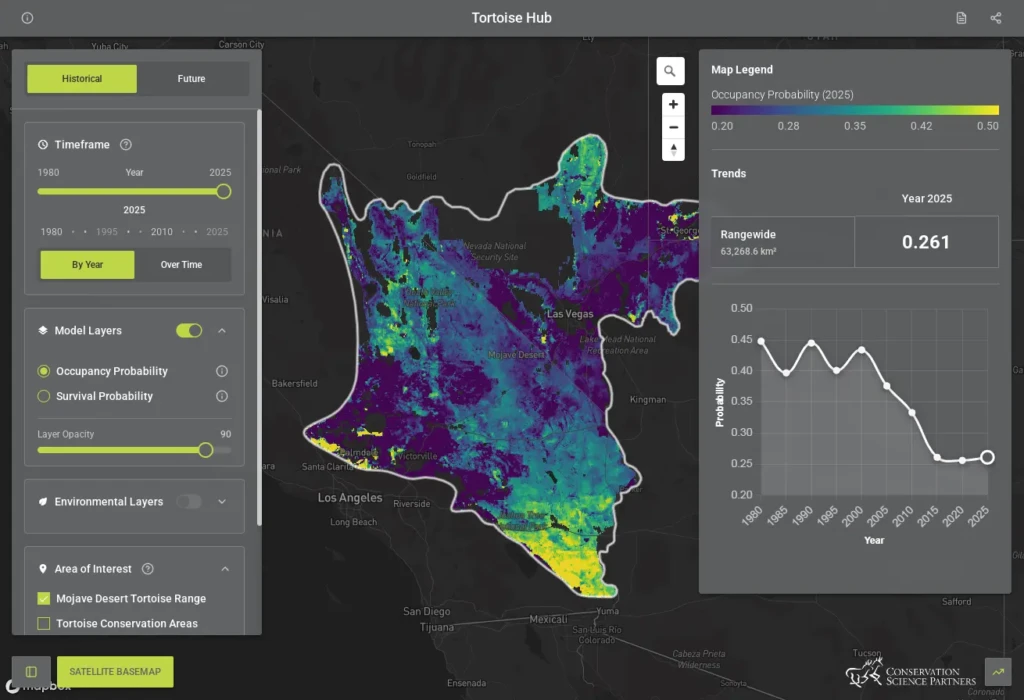

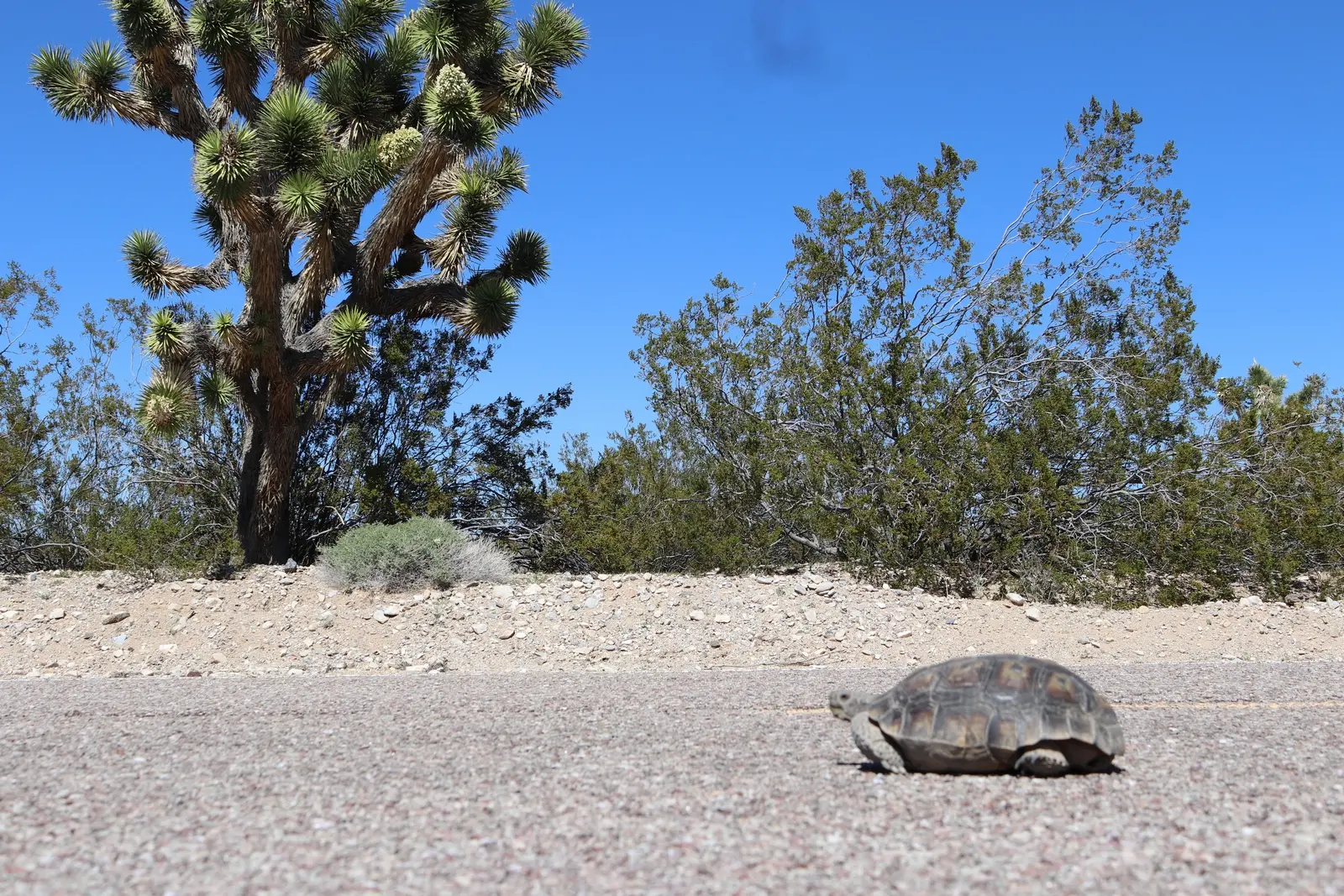
We are excited to introduce our newest web application: the CSP Tortoise Hub, featuring the results of a first-of-its-kind analysis leveraging range-wide monitoring and environmental data spanning more than 50 years to understand how Mojave desert tortoise (Gopherus agassizii) populations respond to multiple stressors. The tortoise has been federally listed as threatened for over thirty years and was recently listed as endangered in California in 2025, but continues to decline across its range. Prior to CSP developing the models underlying this application, the impacts of multiple environmental stressors on tortoise populations had remained largely unquantified.
This interactive web application allows users to explore patterns of Mojave desert tortoise occupancy and survival probability alongside a suite of environmental datasets and context layers. Developed as part of a recent Department of Defense Strategic Environmental Research and Development Program (SERDP) project, the web application makes the results of advanced statistical models accessible to a broad audience through an intuitive, map-based interface. Users can not only visualize historical and contemporary tortoise survival and occupancy, but also explore predicted survival and occupancy probabilities under projected future exposure scenarios, including invasive plants, climate change, off-highway vehicles, and predation pressure. As new environmental data become available, many of these maps of survival and occupancy will automatically update as well.
The web application also allows users to view and generate summary statistics within several polygons representing potential areas of interest, or a user could upload their own polygon. By translating these analysis results into an interactive decision-support tool, CSP aims to make cutting-edge science more accessible for on-the-ground conservation planning.